This is a jumble of notes from a recent play-through I did of Dishonored. It isn’t a true deconstruct but does take note of certain opinions that I will note are my own.
One of my favorite types of games are Immersive Sims; games like Bioshock, and Thief, that present the player with general goals that can be solved using a number of different methods. Most Imm-Sims allow for the player to dictate their gameplay, like using Plasmids in Bioshock, and have levels built with the intent of using different methods to work through those environments. Each play-through is rarely the same and the genre allows for so much flexibility that there is often large opportunity for replays. Dishonored delivers all of this and so much more with a rich story, interesting mechanics, and reactions to the player that even twelve years later it still holds a lot of its initial appeal.
As a companion piece to this write up, I want to link to this YouTube Video that does a great commentary on Dishonored all these years later. If you find yourself getting less than 20 minutes in and wanting to just play the dang game all over again, you aren’t alone. I will note, it is available to play on Game Pass currently.
Introduction
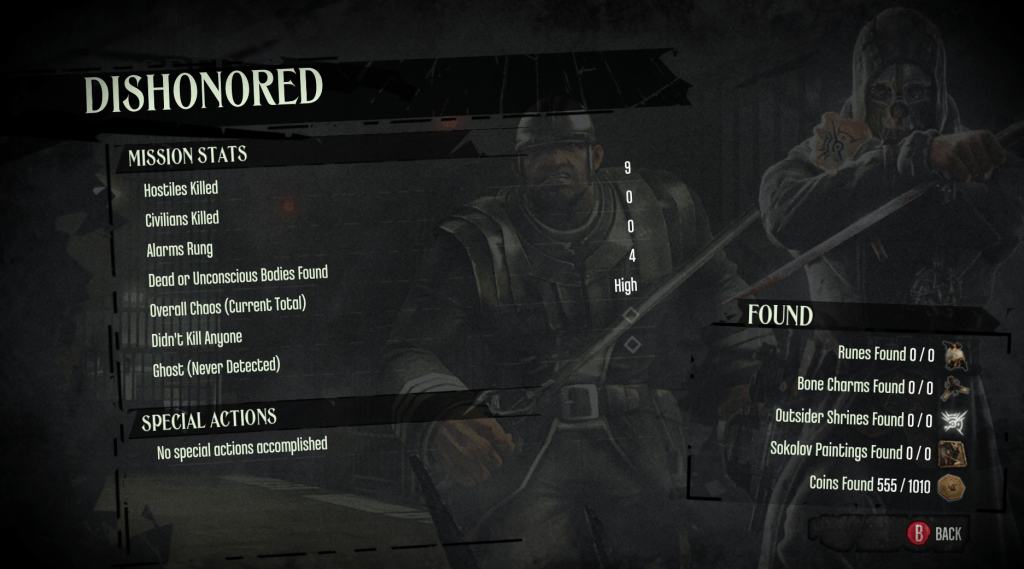
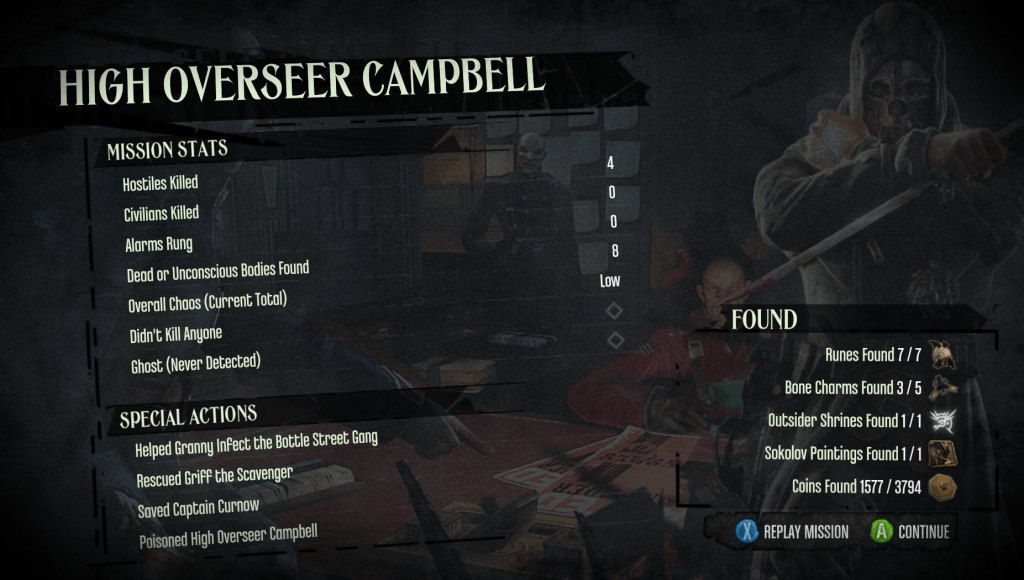
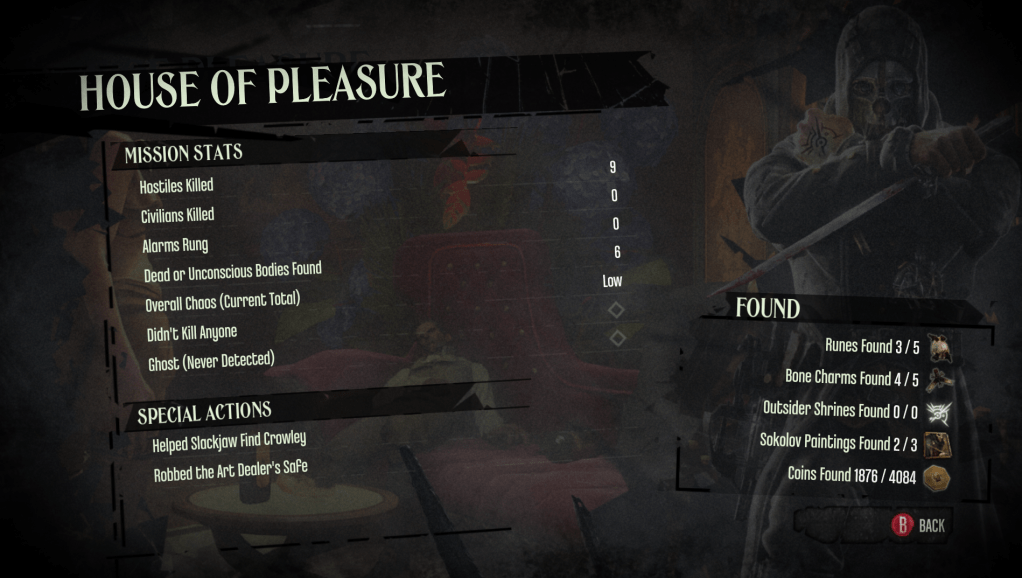
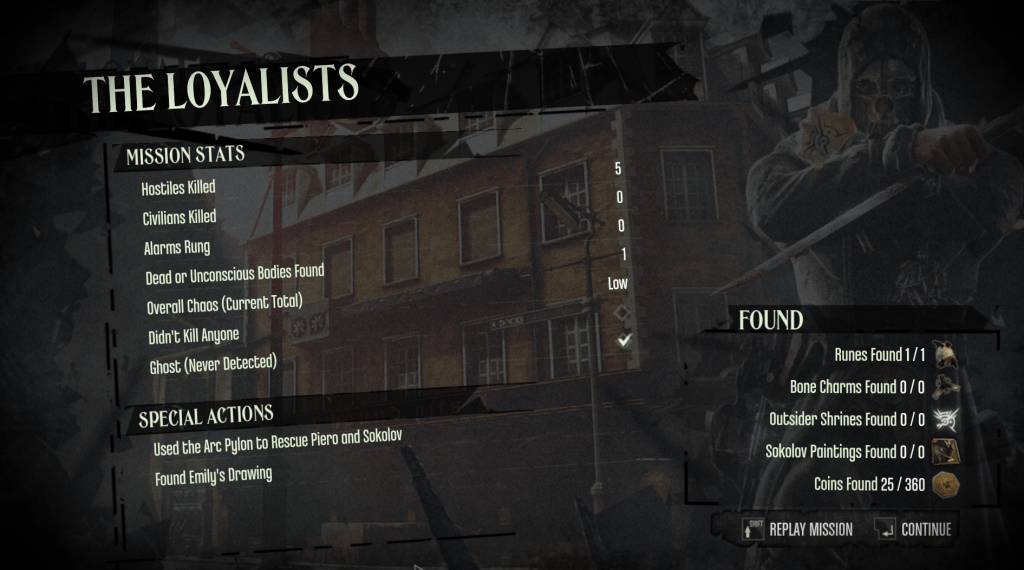
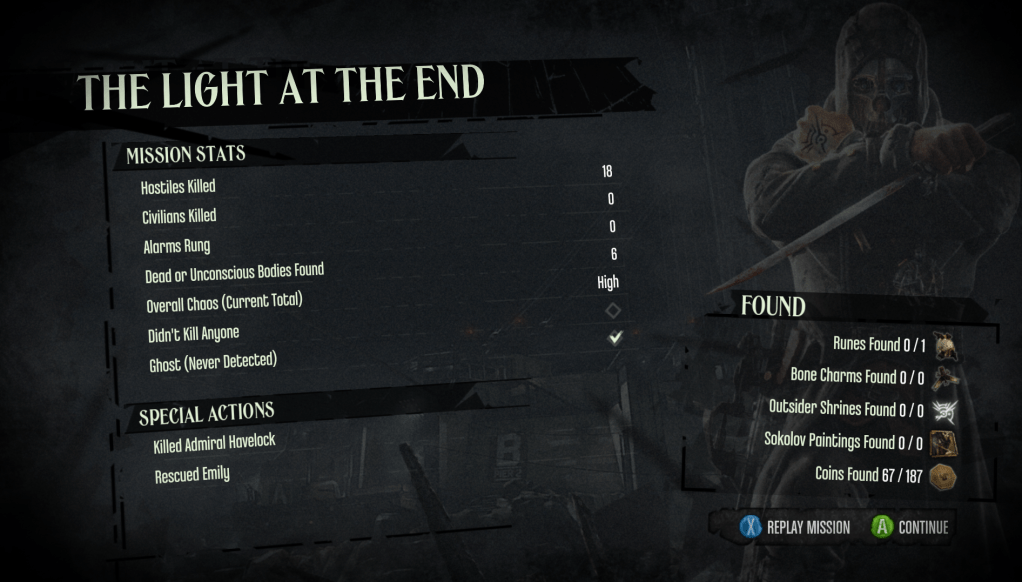
This wasn’t my first playthrough of the game but it was the first in which I intentionally attempted a low chaos score and minimal kills. I couldn’t make it through all the missions as a ghost, but I was able to do it in the final missions, possibly because they were more heavily scripted. I found myself constantly in a state of spamming the Quick Save button. One of the reasons I would do this would be to setup a scenario so I could go completely chaotic to see how things would play out, and then restart my save in order to play less chaotically. One of my favorite phrases that I’d constantly repeat as a result of this experiment was, “Whoa, I didn’t know I could do that!”.
Results
Systems
- Blink+Choke is one of my favorite stealthy tactics. I learned to do this early on and spent the majority of my playthrough using this tactic to do most non-lethal takedowns.
- Blink is one of the most useful abilities for avoiding detection, quick movement, and access to verticality.
- I did not know the Rewire Tool was a consumable until I wasn’t able to rewire a Walls of Light interaction. I may have missed the tutorial or note about this item’s functionality early on.
- Improved jump (Movement Upgrade) feels weird and cartoony compared to the rest of the game. Completely jarring when seeing it for the first time or resuming play.
- Dark Vision makes the world look really ugly. The player ends up spending most of their stealth play-through in this mode and it’s unfortunate because it desaturates the world and makes it less interesting to look at.
Gameplay
- Shadows help keep player awareness down. I found myself enjoying the stealth-like nature of how light and dark play together. This kind of functionality really makes it feel like the player is immersed in their environment and have to utilize the shadows to stay hidden.
- Dynamic lighting (Wall of Light, rotating spotlights) helps the player feel immersed but also functions as a stealth mechanic. I could either bypass them using stealth, or plan to tactically disable them.
- Quick save has come in handy when trying to work through a stealth play-through.
- I need to emphasize this. This game would be absolutely impossible without a quick save.
- Stealth tools seem limited compared to those abilities that create a lot of chaos or kills. I would rarely use grenades, barely fired my gun, and generally avoided tools/weapons that seemed to create too many stims.
- If there was a way to silence my gun, or turn a grenade into a smoke bomb I think I would have had more utilization for those tools.
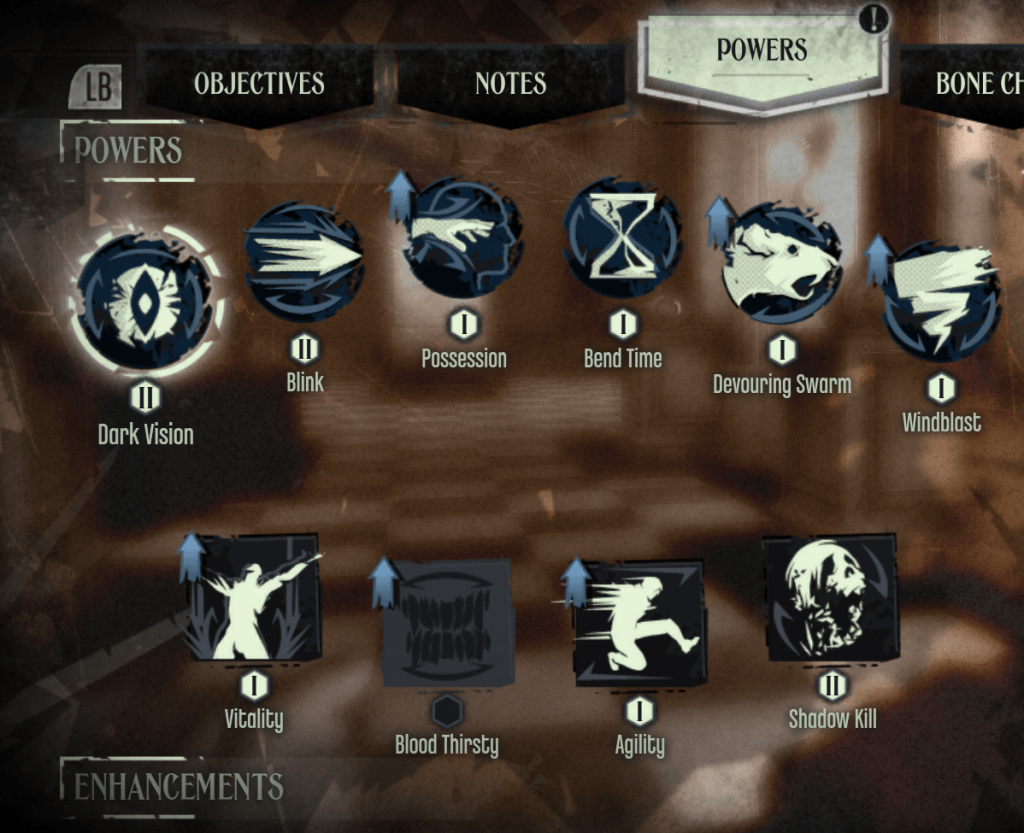
- Some Powers and Enhancements I didn’t bother ever buying. I purchased most of the powers but didn’t upgrade many of them outside of Dark Vision, Blink, Agility, and Shadow Kill.
- Shadow Kill took me awhile to invest into in the first place; I had a misconception that it could have affected my chaos by increasing my kill count. It’s an unusual misconception, but for some reason I thought lethal takedowns would work against me in some way.
- I also didn’t spend a lot of time with melee combat so I didn’t invest in adrenaline.
Level Design
- Good amount of verticality in the maps. I was able to use Blink and jump accordingly. It also allowed me an opportunity to have a “bird’s eye” view and allowed for quick scanning of areas to avoid patrols and develop a tactical strategy for a non-lethal play-through.
- Good use of space within the map. It adds variety to player tactics and I like how most of the spaces make sense in relativity to problem-solving (e.g. gaining access to an adjoining room that appears to be blocked off but could still be accessed through a different point in the map).
Missions
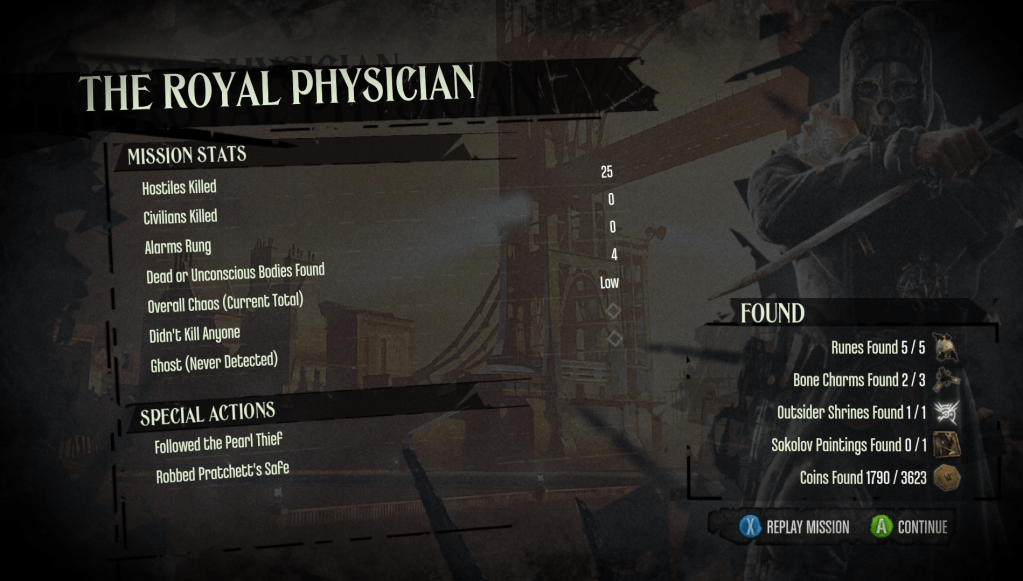
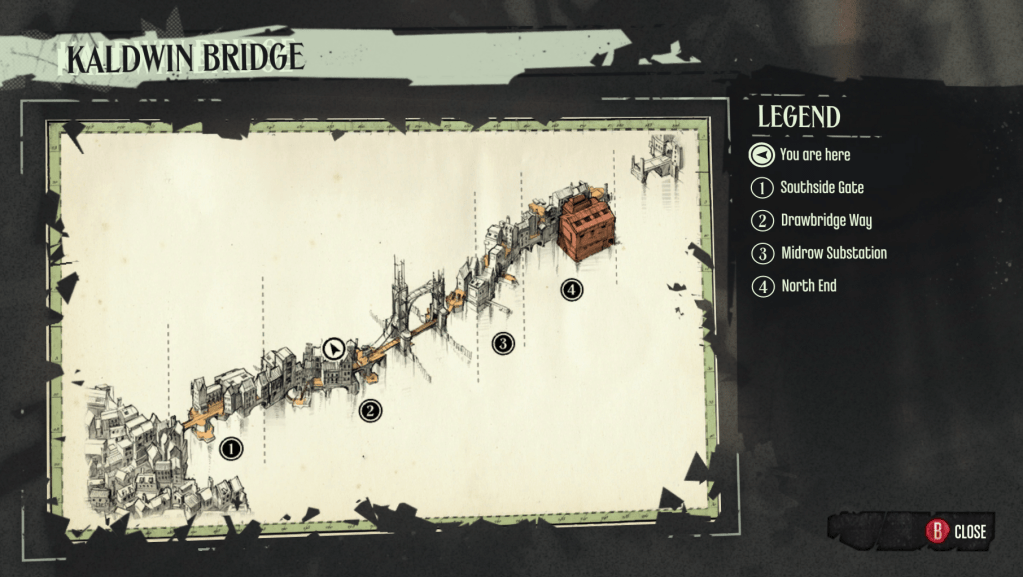
- The Royal Physician mission’s levels feel the most linear (so far) in my playthrough. The zones are smaller and seem to have minimal traversal options compared to previous mission maps. It’s a bridge so I understand that the level options are limited, and it’s a nitpicky complaint, but it just felt like the most “grindy” and least interesting setup for working through a level.
- This is also my least favorite mission. This was probably a difficult mission to balance since it’s mid-level and players probably aren’t quite as specialized or maxed out in certain abilities.
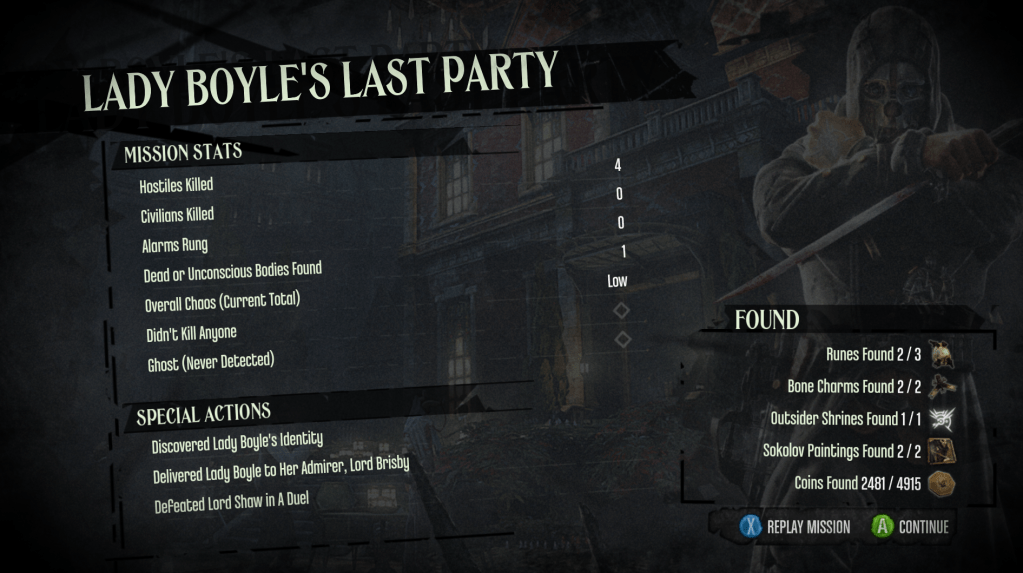
- Lady Boyle’s Last Party has been my favorite mission so far. I like that it requires a different stealthing tactic to interact with the world.
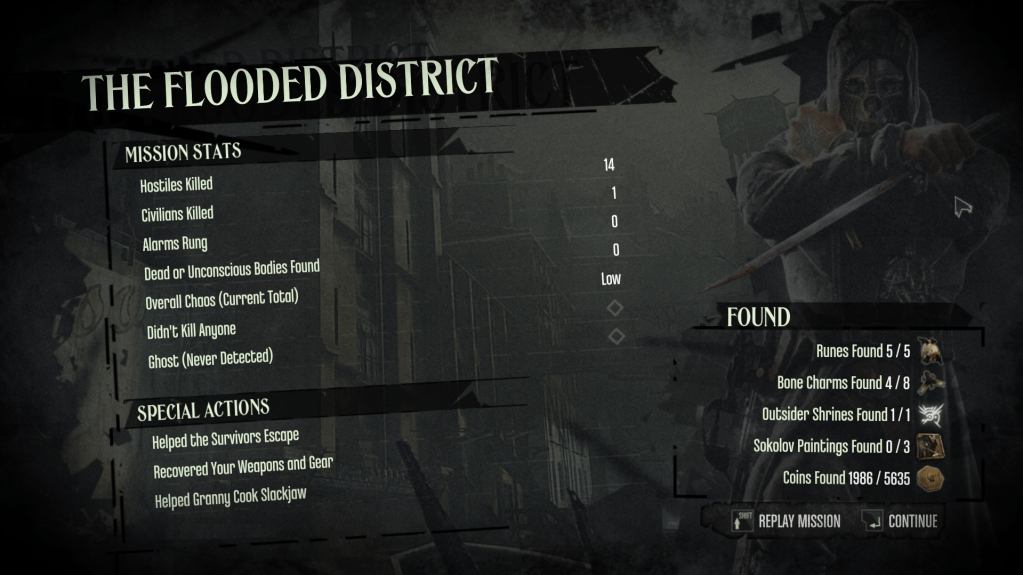
- The Flooded District: At first I was annoyed that my gear and equipment were taken, but then I realized I was getting too used to certain tools and weapons.
- Having a humbling experience that required me to use an even more limited set of tools and even more patience with stealth was an interesting challenge.
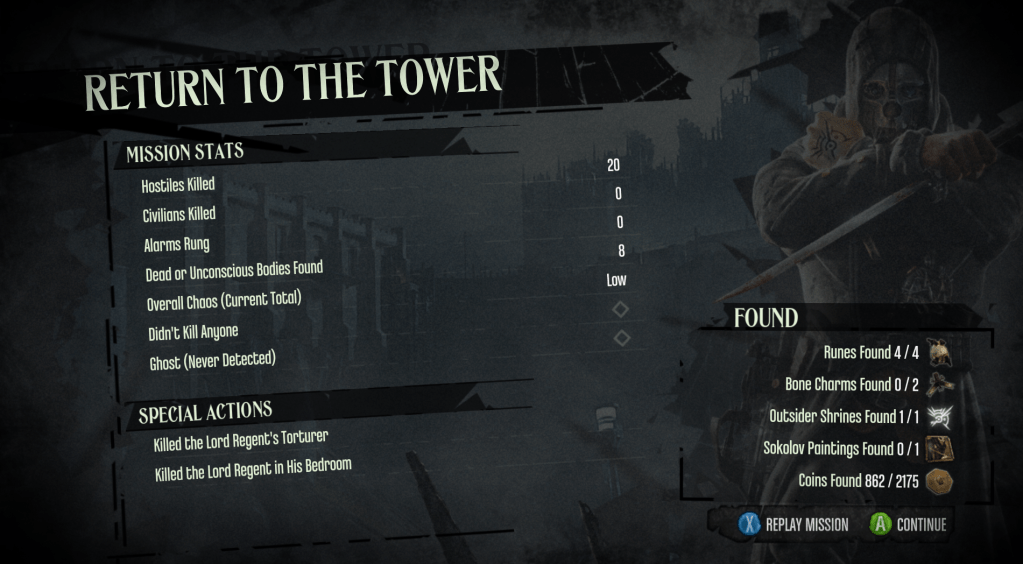
- The last moments of the game for me felt really short. I was able to sneak up on the final target and take him out before any big battle happened. This was a low chaos play-through so the level and outcome were going to be completely different from the other options. I was able to enter the area without the main target knowing and did a typical Blink + Takedown making the end result feel anti-climatic.
Final Thoughts
It’s hard to really believe that Dishonored is a game that’s approaching 12 years old. The way a player can interact and manipulate things in the level to solve problems is one of the reasons this game still feels unique with each play-through. Having a game that measures just how much the player’s influence on the world by using a chaos meter and the tactic in which players take out NPCs (either by non-lethal takedown, or by killing the NPC, which could affect the number of rats in the city and increasing the chance of infected to appear) creates a responsive loop for the player.
My biggest complaints about the game are minor nitpicks in general; I dislike the way the world looks when I’m using Dark Vision, the Agility upgrades seem disjointed compared to the rest of the game (e.g. The increased jump range now feels cartoony), and how tool capabilities seem really limited when trying to go for a stealth play-through. It didn’t affect my play-through much in the way of problem-solving or completing missions, but it’s worth noting some of the critiques.
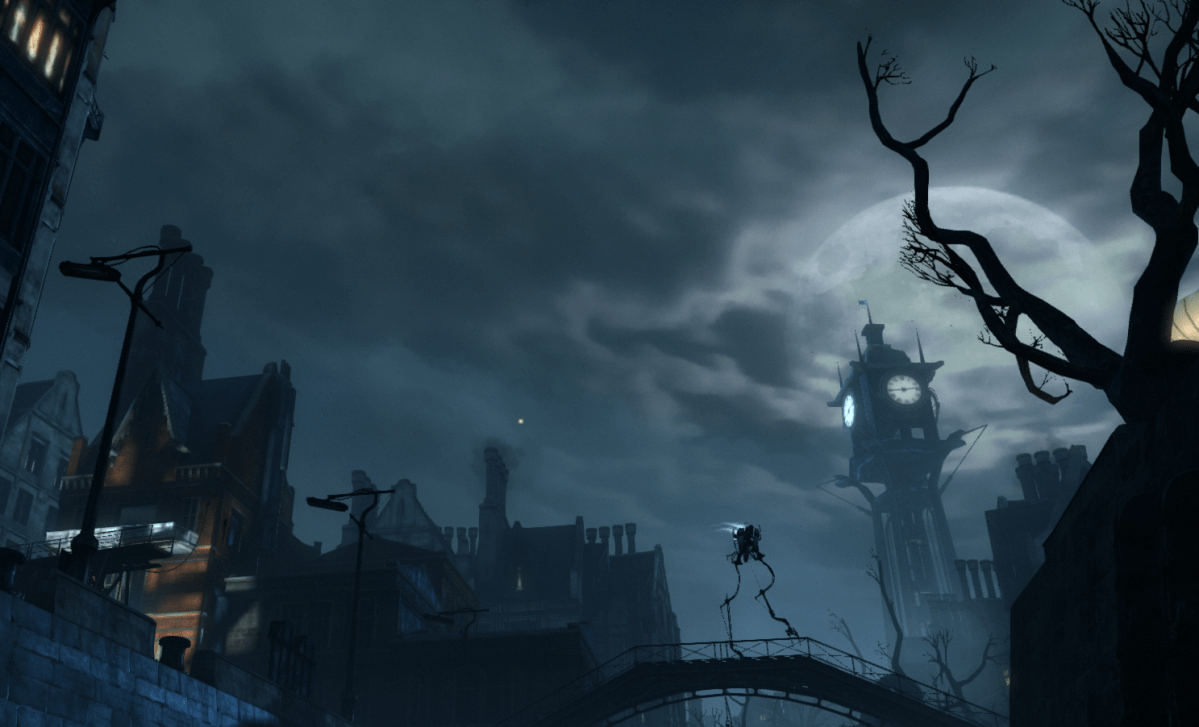
One of my favorite things about this game is how well it presents itself, artistically. There were a lot of moments where I was just mesmerized by the world setup and environment that I was caught off guard by wandering NPCs. There wasn’t a lot of exposition to the game and it was easy to jump into without worrying about a long ramp-up on getting familiar with the game and systems. Overall, it’s still one of my favorite games and I’m probably going to do another play-through soon.
 Valerie Kromas